
In this article
Wood accent walls can frame a bedroom with slats, fluted panels, broad veneer sheets, planks, or decorative trim. Choose the pattern, finish, and coverage around your bed, existing wood tones, and available wall space.
Compare nine designs, then choose a wood tone and coverage that suit your bedroom. Each idea explains its visual effect, a room where it can work, and the details to check before ordering or discussing a project.
9 Wood Accent Wall Ideas for Bedrooms
These nine ideas offer different ways to shape a wood accent wall: through spacing, surface profile, board direction, geometric layout, or the character of aged wood. The examples include natural wood finishes as well as painted wood or MDF trim and paneling. They are design options rather than mutually exclusive product categories; reclaimed boards, for example, can run horizontally or vertically. Tone and coverage are separate choices. Compare each option with your headboard, existing finishes, and everyday textiles.
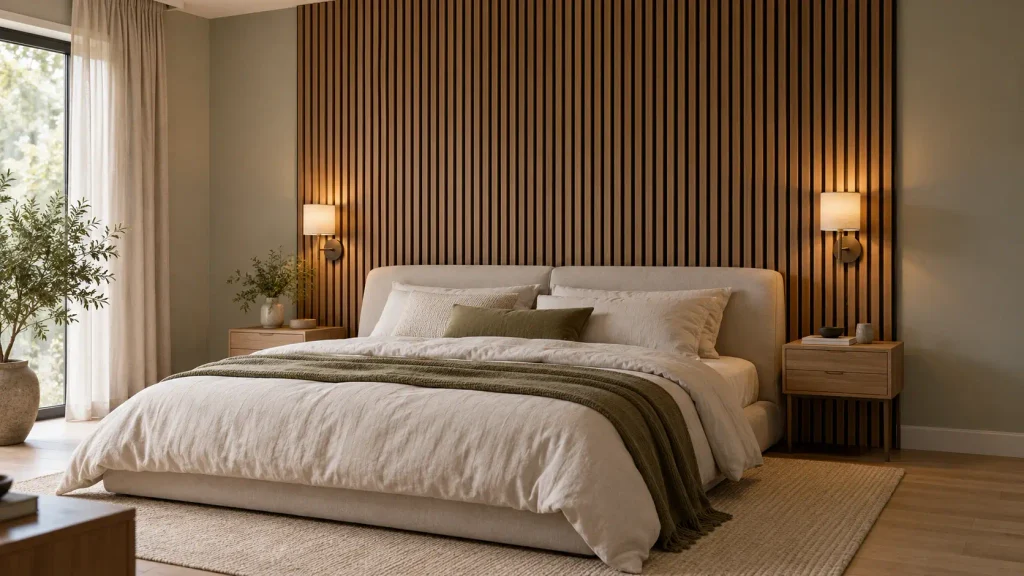
1. Vertical Wood Slats
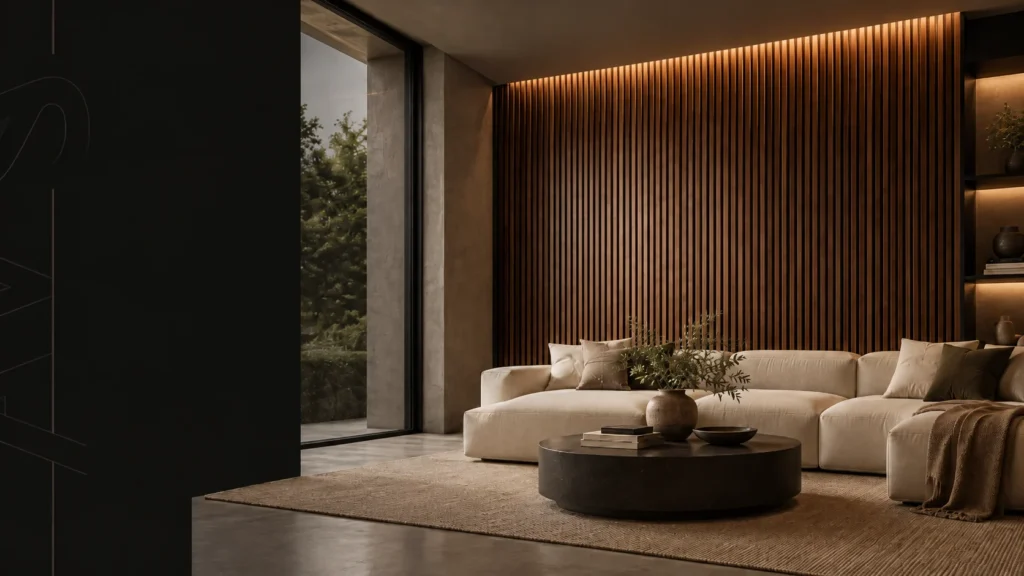
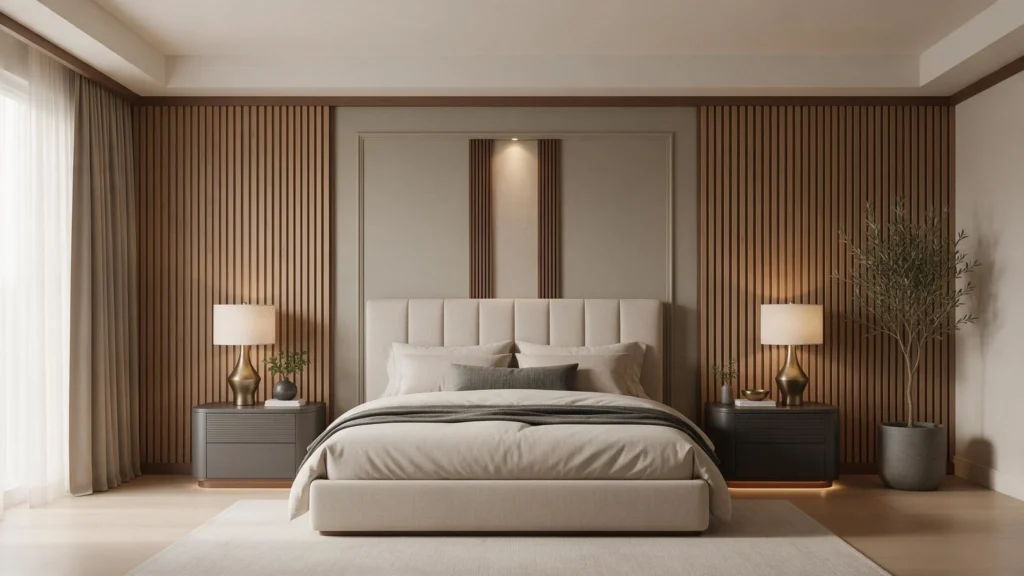
Vertical wood slats are narrow upright strips with visible gaps between them. They may be solid wood or a veneered composite, depending on the product. The exposed wall or backing, slat width, and spacing shape the effect. A dark backing can create a graphic rhythm; a backing closer to the slat tone can soften the contrast. Slats may be installed individually or supplied as ready-made panels.
Picture a bedroom with a low oatmeal-upholstered headboard, a pale floor, and two nightstands. A limited slat field can frame the whole furniture group while leaving painted wall visible at both sides. Check where those edges fall relative to the nightstands rather than assuming that they must align exactly. The repeated vertical lines give this example its structure.
Before choosing slats, check what shows above the headboard and between the bed and the nightstands. Frequent vertical lines can compete with a striped duvet or patterned curtains. Find out where the panel edges and wall lights fall as well: a sconce mounted over a gap reads differently from one mounted on a slat.
2. Fluted Wood Panels
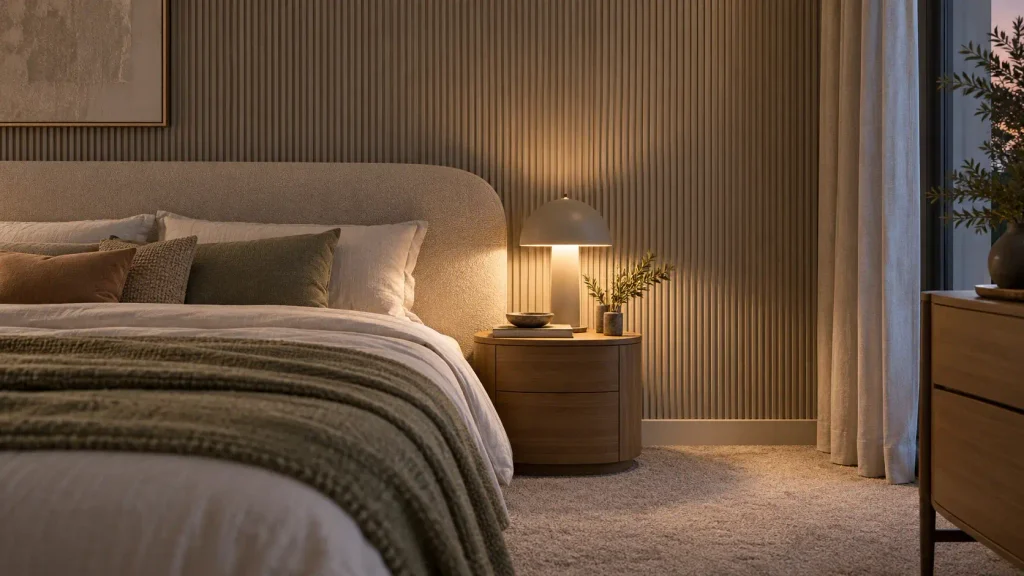
Fluted wood panels have a repeating profile of ridges and grooves formed into a continuous face. Unlike slats, they have no open gaps to a backing, so the pattern comes from relief and shadow. The trade uses the terms fluted, reeded, and tambour for products that are not always the same. Not every profile is round and not every panel is flexible, so check the profile drawing and the actual construction of the product.
In a bedroom with a curved upholstered headboard and a warm-gray carpet, fine fluting adds a second, firmer texture beside the fabric. Side lighting can reveal the relief in the evening, but its angle and beam determine the shadows. Test the proposed light with a sample and check comfort from the bed as well as the appearance of the wall.
Compare profile depth and spacing on a sample under your own lighting. Look at how module joints show and how the panels end at the baseboard. Deeper relief may collect dust, so consider how you would clean it.
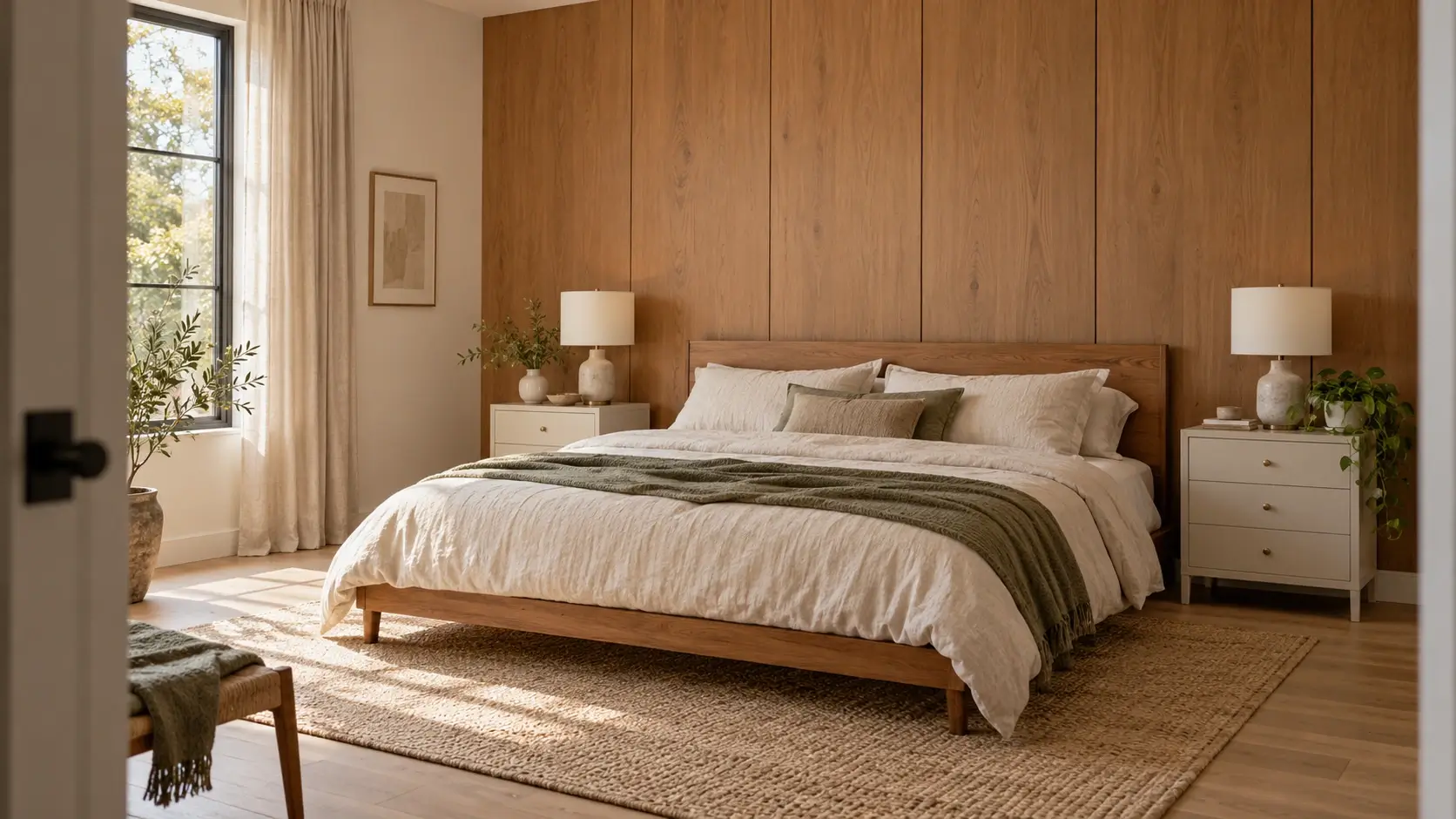
3. Wide Wood and Veneer Panels
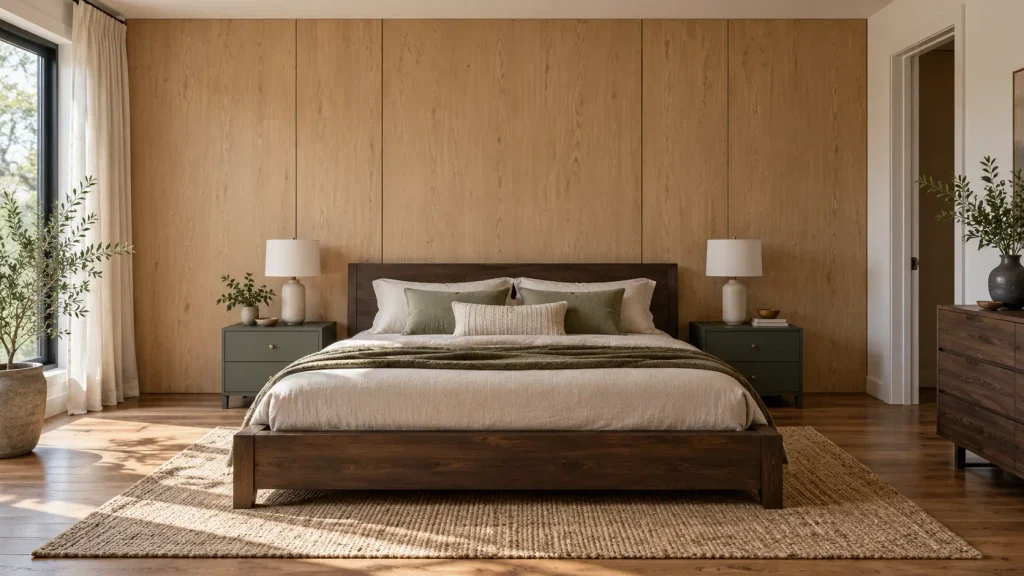
Wide wood and veneer panels replace many thin lines with larger fields of grain. A natural veneer panel has a thin layer of real wood over a backing material; it is different from both solid wood and a printed wood-look surface. A restrained grain can provide a quieter backdrop beside patterned bedding or a figured floor, while strongly marked veneer may become the room’s main pattern.
Imagine broad oak-veneer panels behind a dark wooden bed with a simple, low headboard and painted nightstands. In this example, a panel is centered on the bed, with joints arranged to either side. A center joint is another valid layout. For a limited bed backdrop, relate the composition to the furniture group; for a full-wall treatment, the room’s architectural boundaries may guide it instead. Compare the actual grain and sheen of both woods.
Check panel size, grain direction, joint positions, and visible edges. Joints are part of the design, since most panel systems show seams. Treat any promise of a seamless surface with caution and ask to see the layout drawing.
4. Horizontal Wood Planks and Shiplap
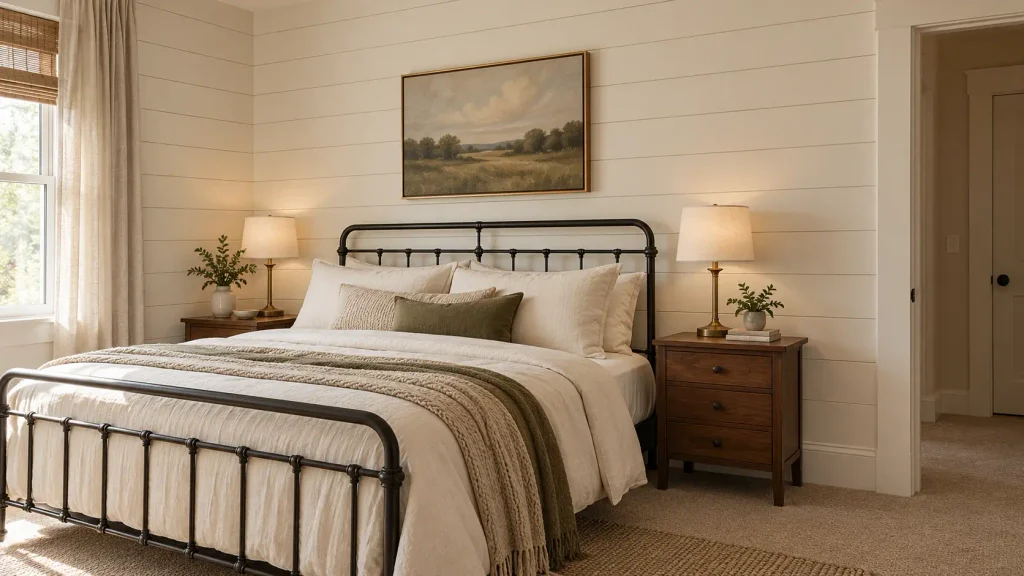
Horizontal wood planks run side to side across the wall, with their width and joints shaping the look. Traditional shiplap uses overlapping rabbeted edges. The visible reveal depends on the product profile and installation, rather than one mandatory gap size. Not every horizontal board wall is shiplap, so check the specified joint.
Take a compact bedroom with a simple dark metal bed, cream bedding, and a beige carpet. Warm-white horizontal shiplap continues behind the bedside furniture to a door casing. The horizontal joints provide the pattern without adding another natural wood grain. Plan the corner, casing, and first and last board courses so that unintended narrow pieces do not dominate the edges.
Horizontal lines are often chosen to emphasize the width of a wall, though the real effect depends on board width, color, and the room. Check the joint lines, the board lengths and how often end joints repeat, and how the board direction relates to a wood floor.
5. Vertical Tongue-and-Groove Paneling
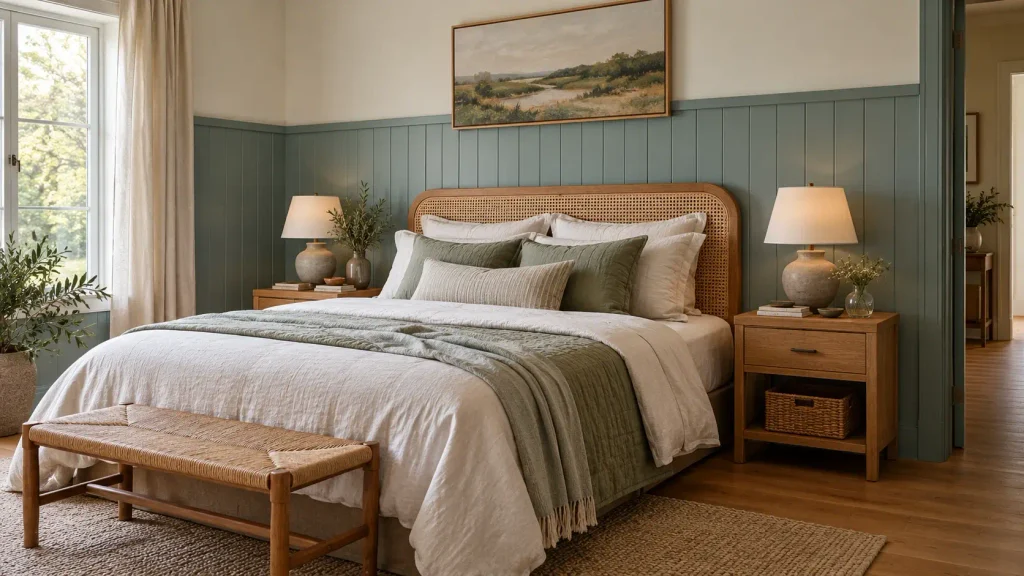
Vertical tongue-and-groove paneling forms a continuous surface of boards locked together edge to edge, with narrow joint lines at regular intervals. The term describes the joint, not a single look: faces can be flat, beaded, or V-grooved, and board widths vary. Compared with slats, there are no open gaps. Compared with fluted panels, the repeating line is usually a joint, not a molded ridge.
Picture muted blue-green vertical paneling behind a medium-height woven headboard in a room with an oak floor. A flat cap rail ends the paneling above the headboard and remains visible across the bed zone. Test that height with the pillows in place rather than applying a fixed distance above the bed. This is one partial-height composition; vertical paneling can also run to the ceiling.
Compare board width and how visible the joints are. Decide on the top finish, and look at how the paneling meets door casings.
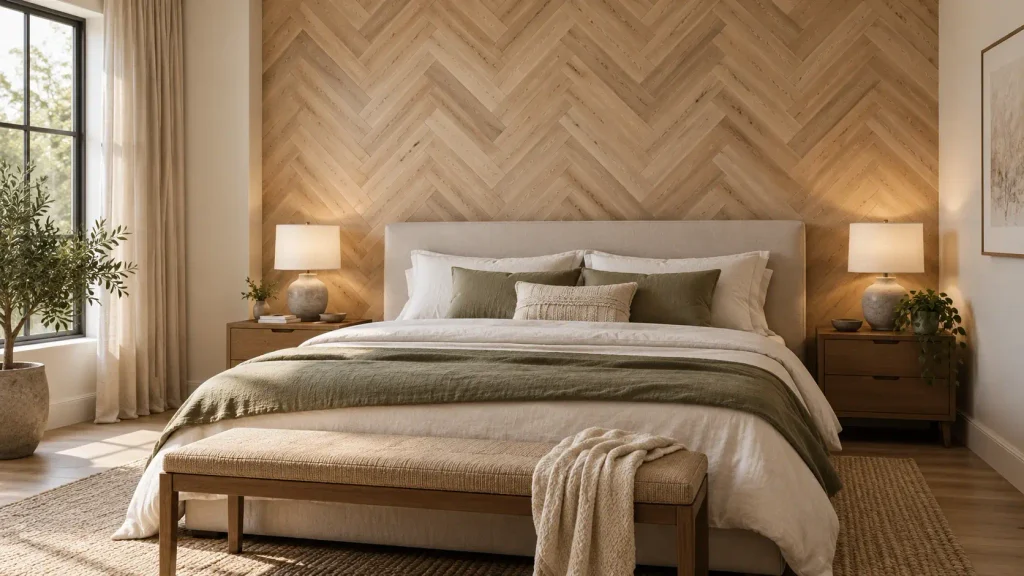
6. Herringbone and Chevron Wood Patterns
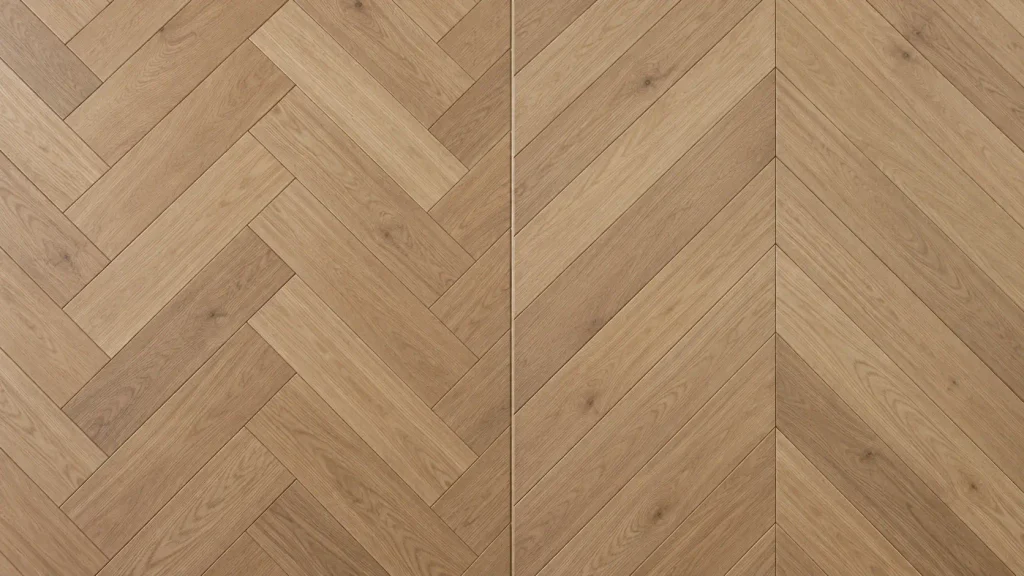
Herringbone and chevron are both diagonal layouts, and the difference lies in how the pieces meet. Herringbone uses rectangular planks with squared ends, set at right angles to each other in a staggered zigzag. Chevron uses planks cut at an angle so that they meet in a continuous V. Either can work on a bedroom wall, so choose by the geometry you prefer and name it correctly in the project brief.
Take a bedroom with a low, solid-color headboard and a limited herringbone field intended to frame the bed. In that example, center the pattern on the furniture group. A full-wall design may instead follow the architectural layout. If the bedding also has a pattern, compare its scale with the wood repeat; a quieter cover or a different repeat may help either element remain readable.
Check the scale of the repeat and where cut pieces fall at the edges. These layouts are visually active and use more cut pieces than straight boards, so they suit a restrained room. Some herringbone and chevron products are designed for floors, so ask the manufacturer whether a specific product is intended for wall use.
7. Reclaimed and Barn Wood
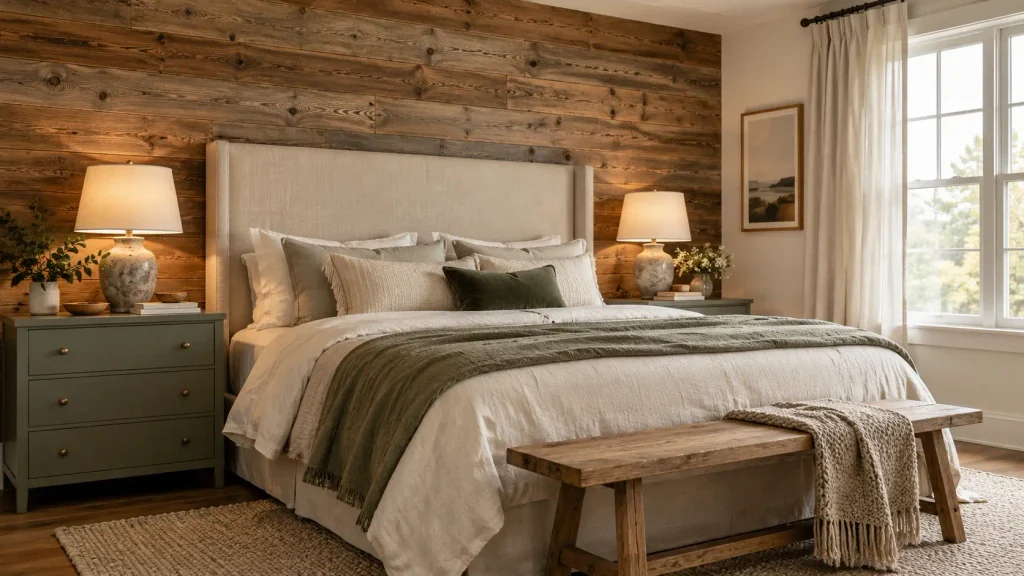
Reclaimed and barn wood can bring variation in tone, knots, saw marks, and traces of previous use. Reclaimed describes the material’s origin rather than a guaranteed look: some recovered boards are refinished to a smoother surface. New wood can also be treated to look weathered. Confirm the origin and finish with the supplier rather than identifying them from a photograph.
In a bedroom with a tall, plain linen headboard and smooth painted nightstands, a selected range of aged boards can give the wall a tactile, informal character. The headboard conceals the lower part of the pattern, so judge the boards that remain visible above and beside it. Choose the range of tones and surface texture together; neither needs to be highly varied.
Look at several boards together, not one sample, to see the full tone range and surface character.
If you like the mixed tones associated with pallet wood, separate that appearance from the source of the boards. An unidentified pallet may have an unclear treatment and use history. Consider a prepared interior wall product with documented origin and condition rather than assuming that any recovered pallet is suitable behind a bed.
8. Geometric Wood Trim
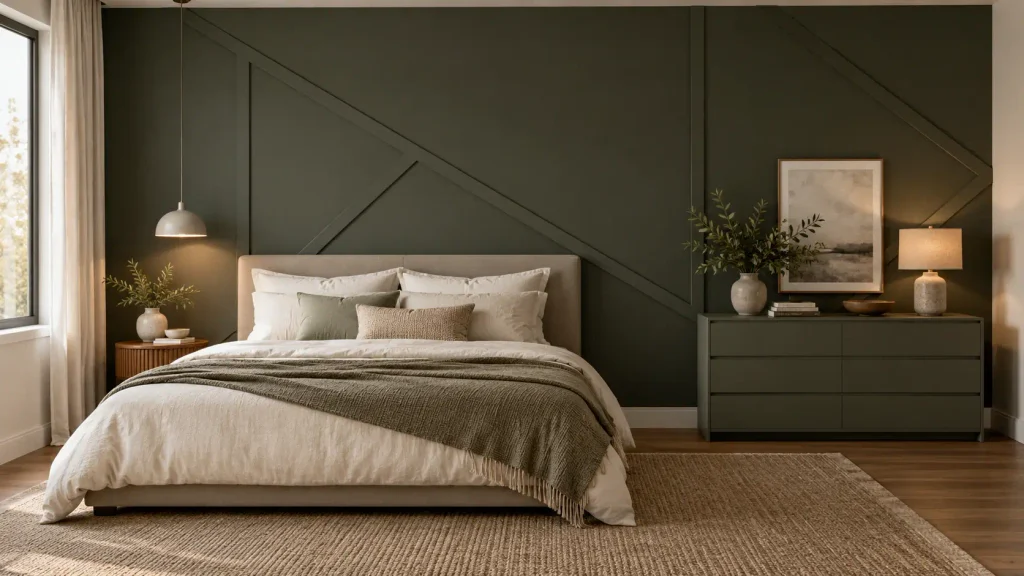
Geometric wood trim applies decorative strips to the wall face in a drawn pattern, such as diagonals, angled frames, or asymmetric shapes. The wall surface stays visible between the lines, which separates this idea from full cladding. Unlike the regular vertical divisions used in many board-and-batten designs (idea 9), geometric trim can form diagonal or asymmetric shapes.
Consider a bed with an offset position, a small round nightstand on one side, and a wider painted chest on the other. A few large shapes can relate the trim to the whole furniture group without requiring identical furniture. Draw the pattern with the headboard in place so that the visible lines form a composition rather than disconnected fragments.
Check which parts of the pattern stay visible and how lines meet corners, doors, and lights. A consistent strip width is a useful starting point; deliberate changes in width are also possible when they are part of the drawing. Specify the material, since painted trim may be solid wood or MDF. MDF is a wood-based composite, not solid wood.
9. Board-and-Batten Designs
Board-and-batten forms regular fields with vertical battens and, in many layouts, horizontal rails that close the rectangles. Not every design is a square grid: batten spacing, rail height, and the number of fields vary. The finish can cover the full wall height or only part of it, which is a separate layout choice.
Consider a muted blue board-and-batten wall behind a tall, plain upholstered headboard. In this example, the bed is centered within a broad field and the battens frame it on either side. A batten on the centerline is another possible layout. Test the field widths and any horizontal rails with the actual headboard and bedside furniture; some concealed lines are normal and do not by themselves make the layout wrong.
Compare section width and how the layout relates to the headboard, doors, outlets, and baseboard. Painted battens give relief and shadow lines, not natural wood grain. If the battens are MDF, the product is wood-based, not solid wood, and a similar-looking option may not be made of natural board.
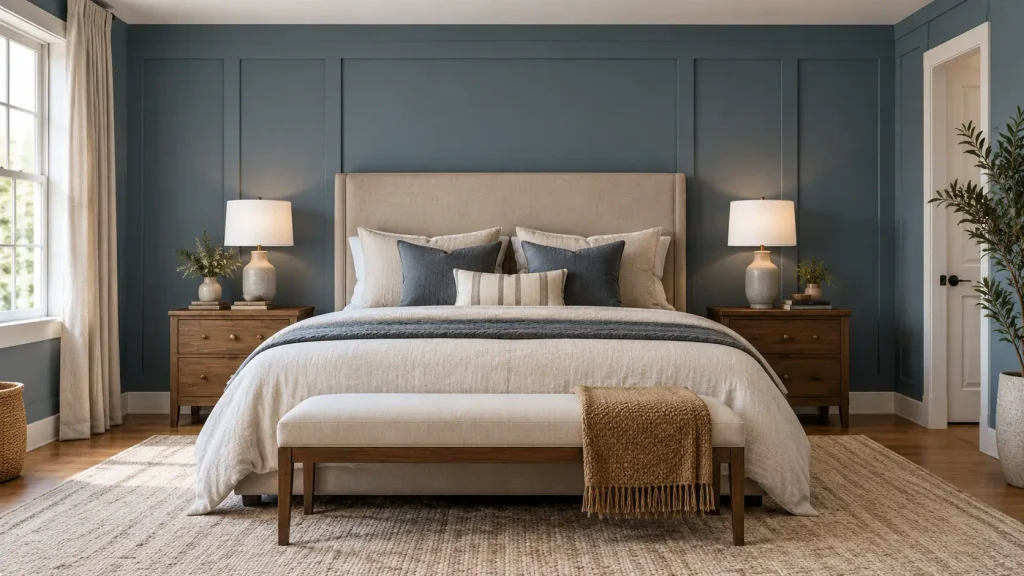
| Design | Visual effect | Check first |
|---|---|---|
| Vertical slats | Repeated lines with open gaps | Slat spacing, backing, and module joins |
| Fluted panels | Continuous relief and shadow | Profile, module edges, and side lighting |
| Wide wood or veneer panels | Broad fields of grain | Grain character, seams, and exposed edges |
| Horizontal planks / shiplap | Horizontal joint lines | Board courses, reveals, and casing junctions |
| Vertical tongue-and-groove | A continuous face with narrow joints | Board width and the cap or ceiling junction |
| Herringbone / chevron | An active diagonal pattern | Pattern type, repeat scale, and edge cuts |
| Reclaimed / barn wood | Aged character and tonal variation | Documented origin, condition, and finish |
| Geometric trim | Large drawn shapes with wall visible between | Visible lines and their relationship to furniture |
| Board-and-batten | Regular fields defined by battens and rails | Field widths, headboard height, and trim junctions |
Use the comparison above to shortlist ideas by the effect you want and the details your room needs. If you are still comparing wood with paint, wallpaper, or other finishes, explore our bedroom accent wall ideas.
Choose a Wood Tone That Works With Your Bedroom
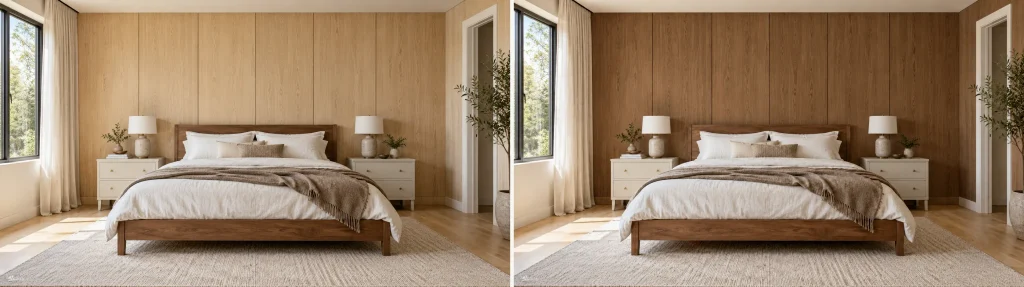
The visible color depends on the species or surface material, any stain or tint, and the finish. A product labeled walnut might contain walnut veneer, be solid walnut, or use walnut as a color description; read the specification. Compare the actual sample with your floor, bed frame, and nightstands, including its grain and sheen.
Closely related wood tones and clear contrasts can both work. Close tones are not automatically a mismatch: compare their undertones, lightness, grain, and sheen in the room. Decide which surface should draw attention instead of treating exact matching or strong contrast as a requirement. The table compares five common directions.
| Wood tone | What to compare in the room | What to check on a sample |
|---|---|---|
| Light wood | Neighbors such as a light floor, white walls, and pale furniture | Whether surfaces merge, and the warm or neutral undertone you want |
| Medium warm tones | Bed frame, nightstands, textiles, and wood details already in the room | How the undertones, grain, and sheen relate; close tones can work together |
| Dark wood | Contrast with the upholstery and with neighboring walls | How visible the pattern and joints stay under evening light |
| White or painted finish | The role of relief instead of visible grain | How readable the profile is, the quality of the paint, and what stays visible |
| Gray, weathered, and pickled finishes | Relationship to the floor and to other cool or muted surfaces | The real undertone and its variation; these finishes are separate looks, not one material |
Consider a bedroom with a strongly figured floor. A panel with restrained grain may leave the floor as the main pattern, while a herringbone wall or strongly figured veneer may introduce another focus. Hold the proposed wall samples vertically beside the floor and furniture, with the grain in its intended direction. Compare the actual combination before choosing.
View the upright samples in daylight and with the bedroom’s evening lamps on. Check color, sheen, and the visibility of joints from the doorway and near the bed. The same finish can look different under those conditions.
Decide How Much of the Wall to Cover
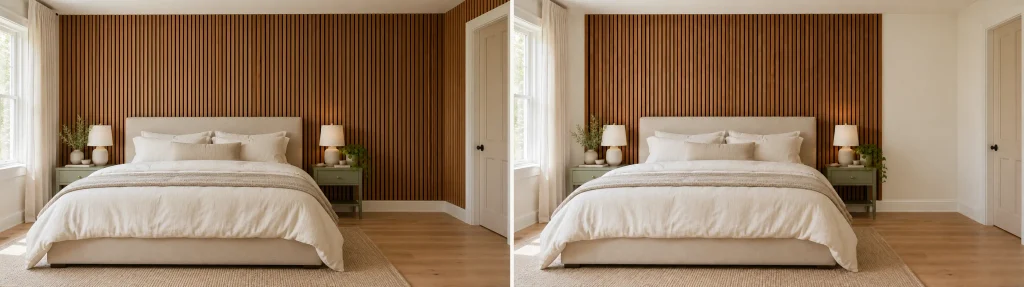
Coverage changes how a wood accent wall reads as much as the pattern does. Three layouts cover most bedrooms: the full wall, a limited field around the bed, and a partial-height finish. The right one depends on the room’s architecture and furniture, not on a fixed share of the wall.
- Full wall: runs from one natural edge to another, such as corner to corner or casing to casing. It reads as part of the room’s architecture.
- Limited field: covers the bed and, if wanted, the nightstands. It reads at headboard scale and avoids awkward cuts when doors or windows make a full-wall finish difficult.
- Partial height: ends at a deliberate top edge with a cap or rail. It suits paneling and board-based patterns, and the top edge becomes part of the design.
Instead of a set number of inches above the headboard, use these checks to place the boundaries:
- How tall and what shape the headboard is, and how much of the pattern stays visible above it.
- Whether the nightstands, outlets, and bedside lights fall inside the field.
- How the side edge and the top edge look up close.
- Where door casings, windows, the baseboard, and any slopes fall.
- Whether the composition follows the bed or the architecture, since the two can have different center lines.
- How the finish looks with the bed and curtains in their real positions.
Adapt the Design to Windows, Small Rooms, and Sloped Ceilings
Windows, limited clearance, and sloped ceilings can affect both the wood treatment you choose and where its edges and joints fall. Check how the proposed design works with these features before fixing the layout.
Windows and an Off-Center Bed
A window interrupts the pattern, so decide where the finish stops before you settle on the pattern: at the casing, at the bed zone, or on the next wall. Curtains cover part of the surface as well, so judge how much wood stays visible with them closed.
An off-center bed does not require symmetry around the full wall. A limited backdrop can follow the bed group, while a full-wall treatment can follow the room’s architectural edges. Compare those layouts before deciding. For help choosing the location, see our guide on which wall to accent in a bedroom.
Small Bedrooms
In a small bedroom, check the total depth of the system, including the backing, fastening, and any air gap, and not only the face panel. That depth matters where a bed, nightstands, or a door swing leave little clearance. Dark wood is not ruled out, and light wood does not always make a room feel larger. Both depend on light, contrast, and how much of the wall they cover.
Practical adjustments include a smaller coverage area, a different pattern scale, or a thinner system. They do not always require choosing a different wall.
See how these adjustments work around beds, windows, and storage in our small bedroom accent wall ideas.
Sloped and Vaulted Ceilings
A sloped or vaulted ceiling creates a choice about where the wall treatment ends. It can follow the slope, stop at a straight horizontal boundary, or continue onto a ceiling plane. Draw the chosen boundary and the pieces that meet it before ordering. Continuing onto the ceiling also requires a product and fixing method suitable for that use.
Check the Material and Details Before Installation
A wood accent wall includes a visible finish and a way of attaching it to a suitable wall; some systems also have a separate backing or substructure. Use the checklist below to compare samples and quotes on the same terms.
- Composition: specify solid wood, natural veneer over a backing, painted wood or MDF parts, or an imitation. For one documented veneered construction, see WoodyWalls’ slat panel specification; it describes that product rather than every slat wall.
- Sample: view more than a small chip. Look at how the pattern repeats, the range of tones, and how panels join.
- Layout: confirm piece width, spacing, joints, the pattern axis, and where cut pieces fall.
- Edges: decide the top and side finish, corners, casings, and the baseboard junction.
- Depth: count the whole assembly with backing, fastening, and any intended air gap, not just the face panel.
- Fixtures: agree the positions of lights, outlets, switches, and any access needs before the finish is planned. Electrical work is a separate job for a qualified electrician.
- Substrate and care: follow the manufacturer’s requirements for the wall and for cleaning. Care differs by material and by profile.
Sound absorption within a room differs from sound isolation between rooms. A tested slat-and-felt assembly may help with the first; decorative slats alone do not establish acoustic performance. Check the manufacturer’s test data and mounting conditions, as illustrated by Finium’s acoustic panel documentation. A product photograph cannot demonstrate noise isolation or better sleep.
Cost depends on the pattern, the material, the condition of the wall, and the labor involved, so a quote based on your actual wall is more reliable than a general figure.
Next Steps for Your Bedroom Wall
Choose two of the nine ideas that fit your headboard, floor, and furniture as they are now. Compare samples of both next to your floor and furniture. Then prepare a photo of the wall, its measurements, and the positions of switches, outlets, and lights. With that material, a designer can review the room with you before any plan is fixed. When you are ready, you can use Request a Consultation to discuss the project with the Vista Wall Design team.
Wood Bedroom Accent Wall FAQs
Can a wood accent wall replace a headboard?
Yes, a wood accent wall can provide a visual backdrop without a separate headboard. If you plan to lean against it, consider the surface texture, comfort, and fixing details. Rough boards or projecting profiles may be less comfortable than upholstery, so assess the actual finish rather than its appearance alone.
Can I install a wood accent wall myself?
It depends on the design. A ready-made module on a flat, sound wall is a different task from a custom layout with cut edges, windows, and fixtures. Follow the documentation of the specific system, and consider professional help for complex geometry or wiring near the wall. Timelines vary by project.
Can wallpaper create a similar wood look?
Wood-look wallpaper or a printed film can reproduce grain and color. Even a textured version does not reproduce the construction or full depth of slats, boards, or veneer panels. Compare the actual surface and care requirements if appearance matters more to you than using real wood.